|
|||||||||||||
|
Research Topics
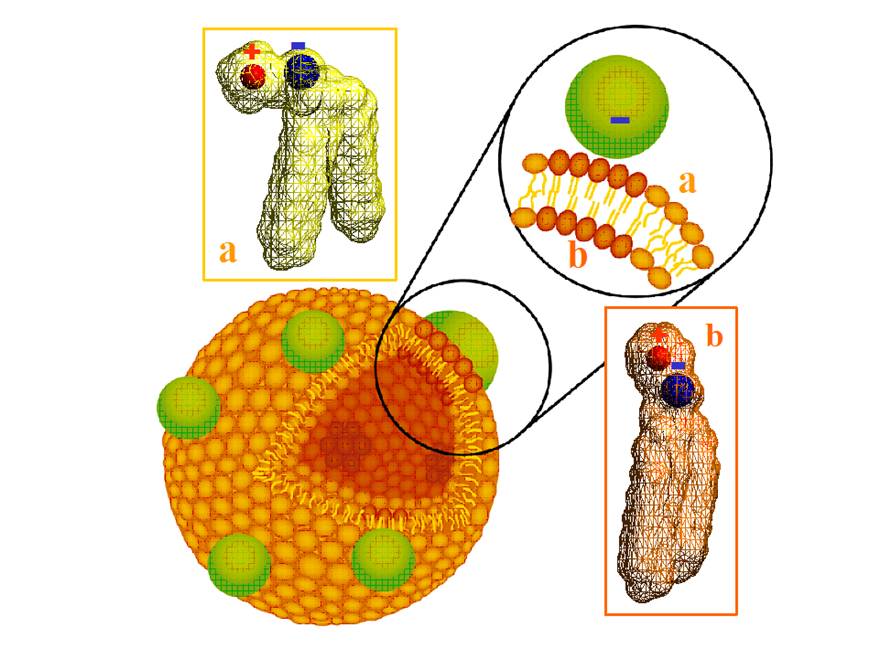
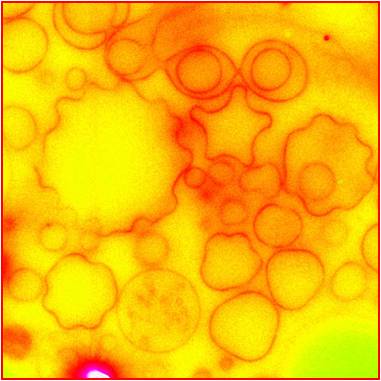
-- Self-assembly of novel, specially-designed colloidal particles -- Living Cells The nonspecific adsorption of charged nanoparticles onto single component phospholipids bilayers bearing phosphocholine headgroups is shown, from fluorescence and calorimetry experiments, to cause surface reconstruction at the points where nanoparticles adsorb. Nanoparticles of negative charge induce local gelation in otherwise fluid bilayers; nanoparticles of positive charge induce otherwise gelled membranes to fluidize locally. Through this mechanism, the phase state deviates from the nominal phase transition temperature by tens of degrees. This work generalizes the notions of environmentally induced surface reconstruction, prominent in metals and semiconductors. Bearing in mind that chemical composition in these single-component lipid bilayers is the same everywhere, this offers a mechanism to generate patchy functional properties in phospholipid membranes.
References
Back to Research |
||||||||||||
|
Contact Webmaster
kchen22@uiuc.edu |
|||||||||||||
|
Copyright © Granick group
|
The Granick research group is an affiliated member of the Materials Research Laboratory,
the Beckman Institute, the Center for Nanoscale Science and Technology. |
||||||||||||