X-Ray Diffraction
The X-Ray Scattering Research Team performs Diffraction
experiments on metal, insulator (C60) and semiconductor (III-V's and
group IV) surfaces and interfaces. The interest in surfaces and
interfaces lies not in merely determining the atomic coordinates, but
in relating that structural information to the physical properties of
that surface or interface. There are a number of excellent and
complementary methods for obtaining this structural information from a
surface; where we use the term surface to refer to a specific type of
interface, specifically a vacuum-crystal interface. However, the same
strengths that make these techniques well suited for surface studies
impede them in interface investigations. For example, electrons used in
low-energy electron diffraction (LEED) strongly interact with atoms
limiting their penetration depth. This results in only a couple of
techniques that can probe and determine the structure of a buried
interface.
X-rays are particularly well suited for these
investigations. Their characteristic wavelengths, on the order of an
angstrom, make them a nearly ideal diffraction probe of atomic
dimensions. In addition, their weak interaction with matter not only
contributes to their unmat ched penetration power, but also allows
straightforward analysis using single scattering kinematic theory.
Unfortunately, this strength is also their greatest drawback for use in
surface studies. However, augmentation of the low surface signal rates
attributable to the x-rays' weak interaction with the "small" number of
surface atoms can be achieved by using a glancing incidence geometry
and/or with the higher intensity beams available at x-ray synchrotrons.
We primarily use synchrotron radiation to perform our
scattering experiments. There are many advantages to using synchrotron
x-rays over conventional laboratory based sources. The availability of
high intensity, tunable monochromatic x-rays or broad spectrum "white"
radiation permit numerous experiments once technically formidable or
infeasible to become routine. These include extended x-ray absorption
fine structure (EXAFS), anomalous or resonant scattering and protein
crystallography. The advent of x-ray sync hrotron sources has
revolutionized materials research using x-rays.
The majority of our experiments to date fall into three
main categories:
- . . . Noble-metal semiconductor interfaces;
- . . . C60 encapsulated surfaces; and,
- . . . Transmission Diffraction and X-ray "RHEED"
|
Photoemission
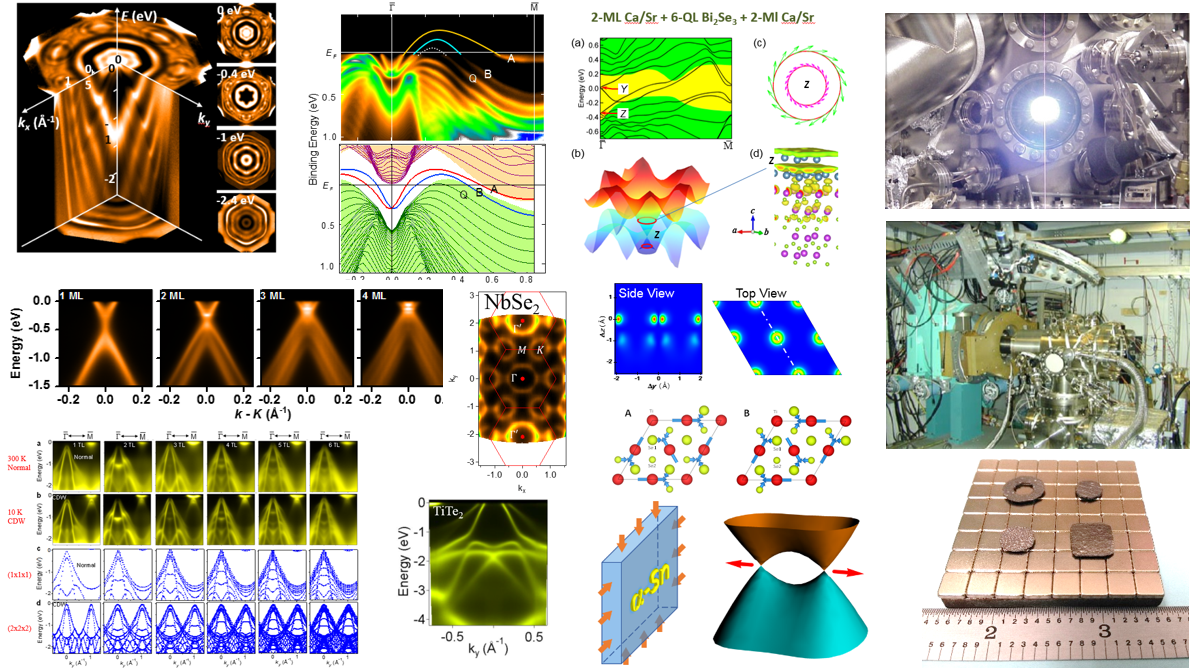
Photoemission spectroscopy (PES) is a surface sensitive
technique which has been applied to the study of many systems.
Electrons are excited from the sample by an incoming beam of photons
and subsequently analyzed by an electron energy analyzer. This
information can be utilized to provide information about the chemical
composition, local bonding arrangement, and electronic structure of the
sample.
Photoemission spectroscopy has many inherent advantages
as a surface science technique. The electrons probed typically arise
from the first few layers of the sample. Electrons can be easily
focused and tuned for analysis and are easily counted. The photoexcited
electrons can also provide information regarding their initial state
energy and momentum. Another advantage over other spectroscopic
techniques using ions or atoms is that the electrons vanish after they
have been detected. Finally, the impinging photon beam leaves the
sample relatively unscathed, so that PES is a non-destructive
technique.
The use of synchrotrons as photon sources has greatly
advanced the capabilities of PES. Previously, monochromatic photons
were only available from the characteristic emission lines of specific
elements (e.g. Al K = 1486.6 eV or He I = 21.22 eV). Not only do
synchrotrons provide access to photons of a continuously tunable
energy, the intensity and energetic resolution provided by synchrotrons
is unmatched. The photons available from synchrotrons arise from, as
one might suspect, synchrotron radiation due to electrons held in a
storage ring. A broad range of photons is produced as the electrons are
bent to travel about the ring. Charged particles traveling in a
nonlinear path will emit electromagnetic radiation. The various
beamlines provide access to a selected energy range of these photons.
They also act to focus the incoming light into a small spot onto the
sample to provide maximum intensity and angular resolution.
|
Publications.
Recent
Publications:
R. Xu, J. Wong, P. Zschack
, H. Hong, and T.-C. Chiang, "Soft phonons in delta-phase plutonium near the delta-alpha transition" EuroPhys. Lett. 82,
26001 (2008).
Y. Liu, N. J. Speer, S.-J. Tang, T. Miller, and T.-C. Chiang, "Interface
induced complex electronic interference structures in Ag films on Ge(111)" Phys. Rev.
B 78, 035443 (2008).
T.-C. Chiang, "Quantum physics of thin metal films"
Bulletin of AAPPS, 81, No.2, 2-10 (2008).
S.-J. Tang, Wen-Kai Chang, Yu-mei Chiu, Hsin-Yi Chen
, Cheng-Maw Cheng, Ku-Ding Tsuei, T. Miller, and T.-C. Chiang,
"Enhancement of subband effective mass in Ag/Ge(111) thin film quantum wells" Phys. Rev. B 78, 245407f
(2008).
R. Xu, H. Hong, P. Zschack, and T.-C. Chiang, "Direct
mapping of phonon dispersion relations in copper by momentum-resolved x-ray calorimetry" Phys. Rev. Lett. 101,
085504 (2008).
H. Hong, R. Xu, A. Alatas, M. Holt, and T.-C. Chiang, "Central
peak and narrow component in x-ray scattering near the displacive phase transition in SrTiO3" Phys. Rev. B 78,
104121 (2008).
Y. Liu, J. J. Paggel, M. H. Upton, T. Miller, and T.-C. Chiang, "Quantized
electronic structure and growth of Pb films on highly oriented pyrolytic graphite" Phys. Rev. B 78,
235437 (2008).
K. Wang, X. Zhang, M. Loy, T.-C. Chiang, and X. Xiao, "Pseudogap mediated by quantum-size effects in lead islands" Phys. Rev. Lett 102,
076801 (2009).
|